




On November 22th 2025, Federmeccanica-Assistal, together with the trade unions FIM, FIOM and UILM, reached an agreement on the renewal of the National Collective Labour Agreement for the metalworking industry, which had expired in June 2024. The agreement defines the new economic and regulatory framework for the sector for the next three years, until June 30th 2028. In addition to pay adjustments, the new Collective Agreement introduces a number of changes affecting work organisation, employee classification and the management of the contractual obligations for companies.
Employers are required to provide employees on open-ended contracts with a copy of the new Agreement between October and December 2026, in order to ensure proper contractual information.
Increases in Base Pay
From a pay perspective, the main development is the increase in base pay, which will be implemented in three instalments to be paid with the June payroll in each of the next three years. For the reference level C3, the total gross monthly increase is €177.62. The table below summarises the new minimum wage for the different contractual levels:
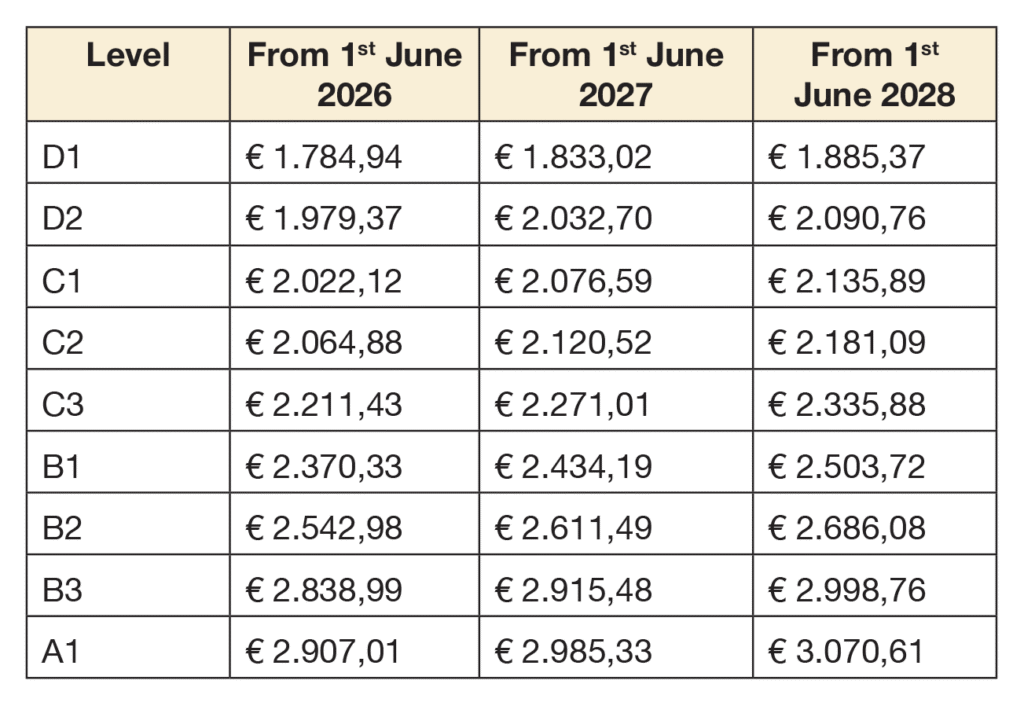
These increases may be absorbed into individual pay increases, unless such increases were expressly granted with a non-absorbability clause.
Welfare Benefits
With effect from 2026, the welfare benefits that companies are required to make available to employees by June 1st each year will increase from €200 to €250. These flexible benefits must be used by May 31st of the following year.
For 2026 only, the amount must be made available by the end of February.
Fixed-Term Employment Contracts – New Reasons and Stabilisation Requirement
For fixed-term employment contracts with a duration exceeding 12 months and up to a maximum of 24 months, it is necessary to specify the reason of the fixed term. The new possible reasons are:
- Workers aged over 50
- Workers under the age of 35 who meet one of the following conditions:
- Have not held regular paid employment for at least six months
- Are the sole adult in their household and have one or more dependants
- Workers who have been receiving extraordinary wage supplementation benefits (Cassa Integrazione Guadagni Straordinaria) for at least six months, or who have been registered as unemployed for at least six months
- Workers employed in connection with exhibitions and trade fairs, from 15 days before to 15 days after the event
- Workers employed in the coordination of projects with a predetermined duration
- Workers employed for specific contracts, orders or assignments of a temporary nature, including cases where the activity extends beyond the originally planned timeframe due to delays caused by external factors.
These reasons must be expressly stated in the individual employment contract and may be legitimately used for extensions and renewals of fixed-term contracts exceeding 12 months and up to a total maximum duration of 24 months.
From January 1st 2027, the use of these reasons will be conditional upon the “stabilisation” (i.e. conversion into permanent employment) of at least 20% of fixed-term contracts that ended in the previous year. Contracts terminated during the probation period, by resignation or by dismissal for just cause are excluded from this calculation.
The specific reasons set out in the agreement are not currently operative and will become applicable only after the signatory parties have formally lifted the procedural reservation attached to the agreement.
Job Classification – Performance of Higher-Level Duties
Employees will be entitled to reclassification to a higher level where they perform duties corresponding to a higher level than their contractual classification for:
- 60 consecutive days, or 120 non-consecutive days within one year, or six non-consecutive months within three years
- 4 consecutive months, or 9 non-consecutive months within three years, for progression to levels B1, B2, B3 and A1.


